Showing posts with label tools. Show all posts

Sunday, February 5, 2012

hands


“Hands that make each day begin again
and bring to light
our distant dreams.”


~ The Monks of Weston Priory, Hands


For the written word to reach the legible surface, an idea must be held buoyant from its depths. Then we form our phrases as they are written down. From eternities and immediate reflexes alike, our hands perform the recording in our own language of thought. The individual is unique and potentially a point of original perspective. Stopping to think about it, I recall the whirlwind of sights, sounds, interactions, and imaginings. A certain slant of light returns parallel seasons past. A radio song on a winter night conjures the hot summer day of its first listening. A turn of phrase from a passerby today brings to life bygone words of a departed soul, and today I’ve handwritten the notes to preserve them.


Through mysterious combinations of intuition and urgency, both conscious and subconscious decisions follow the determining of which ideas will be gleaned for exploration. The process continues, even during moments of setting words to paper. It seems that any in-process apprehensions that ensue are due to notions that the initial jottings cannot be changed and recomposed. Of course they can, and that very thought should encourage further writing. Documentation provides a basis for expanding thoughts and aspirations. The written page becomes something of a reflection pool. Human hands miraculously serve as the intermediary instruments between soul and writing implements.


Hands are the finest, most intricate, and amenable of tools. Instruments capable of making instruments. Our hands were created for us; we haven’t made them. I’ve long thought of my own hands as inheritances from my artistic forbears. There isn’t far to look for me to notice the painters, photographers, furniture makers, tailors, and musicians that have preceded me from both sides of my family. At times, my hands remind me of the family members I most closely resemble- and of those I’ve been told I resemble. Those glimpses usually happen when I notice how I draw, or prepare food, or repair books, or handwrite. A few years ago, it occurred to me how my penmanship merges the styles of both my parents equally. My mother had taught me to write, and that made me impervious to absorbing the official writing style taught at school. Gratitude, in this regard, isn’t so much for a peculiar orthography of calligraphic vertical loops and dotted capital I’s, but more about how the letters and their application form an individual’s development.


By cultivating the human touch to concept and action alike, the soul can creatively venture out. Beyond what is crafted by hand, instruments and visual media can become extensions of operating hands, demonstrating an individual’s comprehension. But beginnings are drawn from the transcendent sensed from within. We animate the materials of our creativity and we can reshape them as well. Keeping that in mind, I’ve noticed how creative methods and tools carry their own respective and intrinsic syntax. Remembering how changing cameras affects and alters my interpretations of subject matter, I’ve found the same phenomenon with writing tools. One writer’s hands shaped to craft with different instruments will write a consistent vision from respectively different vantage points. The individual’s touch begins with formulating thoughts, but is made manifest through commanding the various materials of documentation. Not only have I found subtleties between how and what I write in pencil as compared to pen- one being more ephemeral and pressure sensitive than the other- but I’ve even noticed syntactical differences among the various typewriters I use. An awareness of what I consider “orthographic syntax” helps to free my thoughts from writing standstills.


In these pages, I’ve often clarified how instruments are means for creativity and not ends in themselves. Perhaps a similar argument can be made for human hands, if not for all material. Of late, my thoughts often turn to differences between what may be considered “sufficient” versus heights that compel conscience to engage. Fine tools and trained hands are given their justice in their dedication and use. There may even be results. Winter reminds us of life’s course, with short days of longshadowed bright sun. A life of ideas and journeys has barely enough hours for appropriate words.

Let us bring out those enshrined writing implements and set forth the manna of our best ideas. Eat on the holiday-only fine china with the good silverware on a Tuesday morning. This world of “virtual reality” can use some more counteractive and authentic expression of encouragement. Let us not permit the inheritances of our souls and hands to be lost in waves of autocomplete. Retrieve and recultivate your handwriting. Spell and sculpt your own narratives. Type on a manual machine from your shoulder muscles. Imagine visiting a town of prefab drab squared structures filled with hoarded beautiful housebuilding lumber, saws, planes, fixtures, furnishings, and chandeliers. Indeed, it is the Spirit that gives life. How about a show of hands?


Thursday, July 8, 2010

process and progress


“Divide each problem
into as many parts as possible;
that each part being more easily conceived,
the whole may be more intelligible.”


~ René Descartes, Discourse on Method


I’ve never been able to write much at home. Writing typically kicks me out of my place. Going out to write surely doesn’t reflect any insufficiency of the home desk or front stoop. Choosing to go someplace especially for the purpose of writing is choosing away from distractions and demands. There is only one thing to do, and that is to make note of the journey. The distance from mind to page becomes more proximate with travel- even a walk across town. Perhaps it’s in the change of venue. Pursuing contemplative and reflective processes draws my steps away from bills, chores, demands, and other such moorings.

Getting out prompts adaptation and awakens the senses. This time, having a rare morning off, these words are joined together in a busy coffeehouse. The servers in this place are creating their offerings with a mix of cheer and methodical authority. It reminds me of how I talk shop with fellow visual artists and writers about projects and tools. Process deserves its due, as those foundational procedures are what allow us to venture forth in our own creative ways. By knowing how a result is reached, the various processes in our midst can be seen to connect and relate. My questions for the café workers are similar to those for my friends who are mechanics, repairers, cobblers, and cooks: with the “new eyes” that admire unfamiliar methodology that inspires crafts familiar to my instincts.


Learning more about creative processes leads to a more conscious appreciation for the disciplines that help make things happen. My life in photography- which began as I taught myself at 15- was steeped in scrupulous applications of calibrated processes. Starting out with cribbing from Morgan & Morgan’s Photo Lab Index with a memo pad in the aisles of B. Dalton’s bookstore on 5th Avenue, and learning more through art college, I so hungered to be fluent in the profession that I followed all the steps and processes I could find and use. By the time I reached the heart of my 14 years in custom photographic lab work, I bought my own copy of Morgan & Morgan, adding in my old notes into the thick tome of formulas, specifications, and logarithmic film charts (classed by manufacturer, beginning with Agfa). With a beam balance, I made my own developers and paper emulsions. Accomplishing all those techniques permitted me to teach them and to be able to look at those arcane photo methods in perspective. There are measured aspects: temperature, quantity, time intervals, and chemical agitation. Parallel to these are human aspects: assessing density, contrast, and color. No instrument can replace a cultivated human eye. A third factor is a consistent and respectful use of the equipment- from optical glass, to densitometers, to gently winding color filters back to zero before making any printing changes. With such command, the ground can be flown away from, the lifting off limited only by creative energy. Somehow, that photo-instinct which I applied every day for years and years manifested in my approaches to cooking, baking, calligraphy, and bookbinding. Reverence for method and practice is followed by the twinning of imagination and intuition.


Setting down the writing materials- with care, of course- I asked the coffeehouse staff about procedure. Comparing notes, there is indeed a specialized methodology to what they create for their discerning audience. After all, Arabica Coffee Company is Portland’s finest and has been for many years. In the sequence of photos (below) Salli barista par excellence graciously described the steps that bring those famous cappuccinos into being:


After the coffee cup has been heated with boiling-hot water,
milk is poured into a beaker to be steamed,
anticipating the finishing steps.


A special blend of espresso beans is finely ground,
and evenly loaded into a measure.


The process of tamping the ground coffee is called dosing.


The coffee is brewed under hundreds of pounds of pressure.


As the fresh coffee is brewed, the beaker
of steamed Maine milk awaits!


Pouring the steamed milk into the thick brewed coffee
is skillfully done here by Salli. The result below, known
as a rosette, resembles a forest fern.


As she set the finished cappuccino down on the counter,
Salli sidearmed a little spoon into the saucer. She said the final drop
of the spoon into its place "is like signing the artwork."


By the end of this quick photo session, a rush of customers diverted us all back to our routines. A few good side-conversations evolved. A fellow calligrapher asked about this essay and the pictures. Mentioning my appreciation for creative disciplines, she offered her opinion that “there isn’t enough discipline in this culture.” Another good friend pulled up a chair and noticed my typewriter and journal. He owns an art gallery, and added his observations about creative processes. As much as there are frameworks to comprehend, we have the serendipity of side conversations to savor.


Processes that may appear unrelated actually do intersect with an individual’s sense of perspective. It is for us to make those connections, beginning by noticing them. Preparing and sizing my materials when conserving a book is the same as my mother’s way of cutting fabric. Writing reports at work has my father’s unambiguous and persuasive language. My best example of craftsmanship as a photographer was learned across town in etching classes taught by a Tamarind Institute lithographer. This instructor had a refreshing willingness to rework her printed images; it was not the discouraging purism I saw in the college photo department. During my high school senior year, I got to meet the great typographer and graphic designer Ismar David. He took me to his drafting table and showed me his sketches for a stone memorial he was designing. I looked wide-eyed around the studio filled with tools, spring-armed lamps, and drawings tacked to the walls, listening to the artist talk about how he wanted visitors to the memorial to understand what they’d see. Mr. David shuffled through a sheaf of pencil schematics on tracing paper that animated all the angles. A three-dimensional design. I remember this as if it happened last week, and these glimpses affirm the role of procedure on a long journey of undetermined structure. Process helps establish foundation. By understanding how something works, we can make things work in our creative pursuits. And as process recedes into second nature, intuition and openness to spirit become procedure.


~ with special thanks to the typewriter-loving, always gracious and supremely neighborly:
Arabica Coffee Company, 2 Free Street, Portland Maine


Monday, June 14, 2010

travelling companions


“Bring me my Bow of burning gold;
Bring me my Arrows of desire:
Bring me my Spear: O clouds unfold!
Bring me my chariot of fire!

I will not cease from Mental Fight,
Nor shall my sword sleep in my hand”


~ William Blake, And Did Those Feet in Ancient Time


(abolitionist preacher's diary, Maine & Vermont, ca.1860s)


Friday, January 15, 2010

graphite alight


“You walk into the room with a pencil in your hand...”

~ Bob Dylan, Ballad of a Thin Man


A reprieve of stillness mercifully interrupted the day’s chaos. With notebook and pencil in hand, I sought the quiet sanctuary of an empty office. After having started writing, it became obvious to me that nothing cohesive was materializing. But I kept noting words- even if some of them were about feeling devoid of anything to say. I wanted some new thoughts, but that hour offered no written developments. So that’s exactly what I wrote. After returning home from work that night, those bedraggled words re-appeared as I opened my journal again. It seemed I’d been foraging for glowing embers using a pencil. It happens, ungratifying as that can be. The aspect for which I do express gratitude is for knowing to reach. Even a few scribbled sentences reveals forward motion.

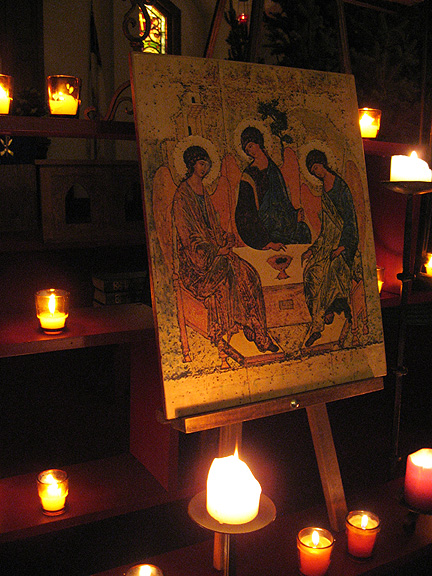
Throughout this recent season of Advent and Epiphany, I’ve travelled to parishes throughout the region, providing music and creating contemplative spaces. Last Sunday night, during the long meditative silence, I glanced up from my sheet music to the front of the sanctuary. Lit only by scattered flickering candles, warm-toned icons met my gaze. These are the same icons that I’ve hefted across thousands of miles, beginning in Taizé, France. Occasionally, I am surprised by the austere mystery on the painted figures and faces. The Spirit invites. Such images are not sources, but brilliant reflections of light that confounds the dark. If darkness is prelude to light, then I must consider my failings and frustrations as prefatory to discovering.


Consider how a physical space appears transformed in our eyes, as our perceptions evolve. The same venue that witnessed anguished desperation can be the setting for elated recognition. Contrasting connotations can be noted anywhere: a café, a busy street, a schoolyard, a workplace, a room in a house. My apartment has been something of a stage for human drama. A downtown diner has been a repeating backdrop for scribing trepidations and for calligraphic catharses alike. Noting how a space is transfigured is to recognize changed realities perceived.

Amidst this reach for understanding is the unfathomable mystery of the origin of light. From there follows the wonder of how a spirit can be re-ignited. If to discover is epiphany, then to arrive is to be present: to alight. The act of alighting is to descend from one place and come to rest in another. Perhaps there is something to note, in my journey, about coming to terms with the Source of life without having seen the Eternal. In Tauler’s exhortation to endure in good cheer, we are to abound in good works for God’s sake. “And then,” he wrote, “shall you be made partakers of overflowing measure that runneth over on all sides.” This alighting touch of grace reaches the brimming human vessel, which “pours itself back again into its Divine source, from whence it has proceeded." In Tauler's description of this mystery, "all knowledge, love, perception are all swallowed up and lost in God, and become one with God." This grandeur challenges my own belief, in that it is more than I think I should ever expect. But perhaps that wouldn't be reaching as I ought. While trying to comprehend these things, why not keep working and keep the pencil moving on the page?


A good friend of mine is a historian of tool-makers and their utilitarian creations. His enthusiasm and expertise has breathed new life into our local Charitable Mechanics' Association- which dates back to Colonial times. Our friendship inspires in both directions. I am becoming attuned to the old ways of production, and he now uses antique typewriters. One day, as I spoke of the "tools of the spiritual life," he quipped, "you've said it all right there. Tools are spiritual." Indeed, we speak in two different senses of the word: implementation of a practice and the physical implements themselves. Surely, the actual tools of the writer (along with the builder and the mechanic) deserve their due. With these writing instruments at our ready, we experience the miraculous- and can create documentation.

As with light, our documenting tools help us liberate our thoughts, our stories, and our voyages. I have seen the worth of keeping the pencil moving- even while reaching and straining for description. And the tools do accommodate, no matter how cold; graphite cannot freeze. These exterior sub-zeroes teach us the value of continual movement. In time, the frozen granite steps will be bathed in spring rains and adorned with ivy.