Showing posts with label walking. Show all posts

Friday, August 15, 2014

y tir


“According to thy name, O God,
so is thy praise unto the ends of the earth.”


~ Psalm 48


y tir (terra)

Timing a sojourn to Wales after an intense term of study turned out to be serendipitous. From the intricate, labyrinthine campuses and cloisters of Oxford, my steps alighted among the coastal mountains of Snowdonia. Very shortly after leaving my bags in the Noddfa house, I walked downhill through the village of Penmaenmawr, to the seashore. Immediately, I realized how soothing it was to be amidst wide open space. The same sensation struck me the following day, hiking in the mountains, and without thinking I swung my outstretched arms like windmill blades. The landscape, seascape, waves, and fresh air reminded me of home. A restful week-and-a-half in North Wales, following a profoundly scholarly experience at Oxford, drew me to savour the terrain, waterways, and skies.


These travels have taught me to treasure each step, each setting and encounter along this providential way. An old Bostonian named James Freeman Clarke once wrote about the cultivated habit of recognizing the miraculous and the beautiful as we navigate our lives. Using the example of a classic poet, Clarke pointed out how “Milton lived in London, but he saw more beauty in one morning’s walk in the country than many country people observe in all their lives.” (Conversely, it may require a country poet to notice the nuances of beauty in places like Boston and London!) But, indeed, a change of air and place can awaken our sense of appreciation for the elements we may otherwise take for granted in our worlds of routines. As I noticed details in the urban layout of Oxford, my impressions upon returning to Wales were equally enhanced. New terrain and the beaten track become intermingled. I remember an occasion, on a boat, when I described the islands near my home on Casco Bay, Maine, as the peaks of undersea mountains. It was simply noticing what was in front of my visitors and me. The terrain in North Wales is as eventful as it is varied, and my many steps sauntered streets, paths, and mountain trails.


enduring paces


Reflecting upon these sojourns, my thoughts mull the distinctions between lands navigated in a place such as Wales, compared to my forgettable workaday trudges. How are my steps and strides in various lands distinguished? After all, the paths are navigated by the same individual- the same pilgrim of trust on earth. The differences are in perception- and place. Granted, and quite obviously, a trail such as the road of the ancient Celtic pilgrims is many times more exotic and rarified than Cumberland Avenue. To be able to equally regard all earthly thoroughfares might require a strong sense of self-awareness combined with a disciplined spirit.


Similar to the old adage about the sea determining the substance of the mariner, the pilgrimage builds the integrity of the pilgrim soul. In turn, the pilgrim determines the worth of the long journey’s paces. An intensified significance especially applies when a sojourn is of our choosing. With every week’s paycheck, the first thing I do is tabulate how many earned-vacation hours I’ve accrued, and then divide that number by 8-hour days. It requires a month of full-time toil to earn a day-and-a-half of liberty. Time is bought at a price. Redeeming time which is at once longed for and cherished, as well as regretted and grieved, is a lifelong comparison. I’d do well to view these daily commutes and staff-meeting shufflings as though en route to the next mountaintop, around the next Neolithic standing boulder, or to the next wellspring. While trying to think of it that way, I hope to make my steps matter.


If our actions produce a memory or an effect that extends beyond our reach, then our steps do as well. Pilgrimages, by definition, are intentional travels to inspiring sources and alongside the very footsteps of our predecessors. In so doing, we generate impressions, making marks of our own. It is as though we contribute to the very achievements we seek to witness. There is increasingly more to remember, as time passes. A handful of small stones I’ve saved from the trails, and the words I wrote in transit, help to recall memorable places navigated. While captivated by the idea and action of motioning and reaching forward, I suddenly wonder who will be seeking our footsteps? Considering milestones and crossroads past, directions taken now have future implications. Travelling linear paths across ancient clearings, forests, and mountains broaden perspective. Our todays may surely meet with the todays of others whom we cannot know. The proverbial pearl of great price, as we know from holy writ, is not isolated without context, but is indeed found in a field. And it is a field we will leverage ourselves to gain.


Abergwyngregyn


proceeding


Through my explorations in Wales and nearby England, I listened to countless pleasant stories about travels to the U.S. It was good to hear about visits to Maine and other parts of New England, with admiration for our respective homes. As well, I was both surprised and heartwarmed at the exuberance about not just the city of New York, but about New Yorkers! A group in north Wales gave me their gleeful renditions of the New York accent, so I cranked mine up, and we all had a very loud time. Learning to attend, observe, and to notice what is around us, returning to James Freeman Clarke’s words, “changes time into life.” He described the skill of observation as a great art.

“Many of us pay half-attention to what we see and hear. Then we do not remember it. Travelling in new countries is useful as calling out the faculty of observation. The traveller feels it his business to notice everything, and often while abroad, is interested in what he has seen at home, but has not noticed it there.”


Along the History Walk, on the Bangor High Street.


The paces of time surely cannot be rewound like a mechanical watch, or turned back by paging through an old calendar. There is an important difference between attentively walking, compared to smothering the terra firma. Awareness is to conscientiously pace oneself. Physical motion looks all the same to the casual observer, yet the intention is as incongruent as arranging a dinner place-setting is from throwing a fragile artifact against a cement floor. We can boorishly bellow, or we can speak and attend with respect. Both require words. The distinction is in the spirit and the delivery.

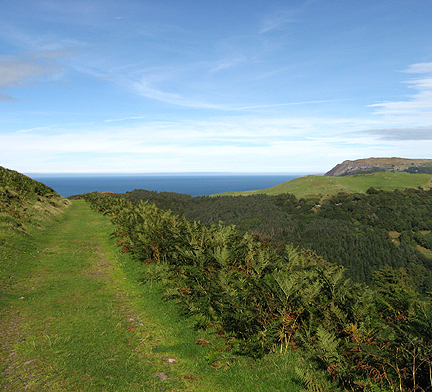


I hope very much to return to Wales, not just to explore new corners and coasts, but also to revisit familiar places. The mountains and hills of Snowdonia will always compel and console. The trails with the best views tend to be the steepest pinches of shoulder-width divots between sharp rocks. Consequently, angular descents compressed my toes into the fronts of my shoes. (For relief, I occasionally descended by walking backwards.) Navigating the notches is entirely worthwhile, with each vista cherished. The way of broadened wonder is paradoxically one that is narrowly focused.


Isle of Anglesey


Walking the land in this pilgrimage of trust on earth lasts the length of life. Newly-found trails are combined with repeated paths. At times, I’ve made opportunities to re-walk the routes that are dearest to me. On other and rare occasions my steps intentionally overlapped past impressions in order to verify and change them. What should I have done that I failed to do? What can be corrected, and redeemed into time? Is the distance ahead worthy of the distance behind- even exceeding it?


Our adventures teach us how to proceed. Among other things, I’ve learned about how an action such as sojourning finds its distinction in its very intent, the spirit beneath the action. Just as a pilgrim can sense the ambiance of a place, so can the ground feel human intention. Seeking the solace of the fair country, I have surely tasted that solace.


Tuesday, February 1, 2011

duly noted


“When we despair of gaining inner transformation
through human powers of will and determination,
we are open to a wonderful new realization:
inner righteousness is a gift from God to be graciously received.
The needed change within us is God’s work, not ours.
The demand is for an inside job, and only God can work from the inside.
We cannot attain or earn this righteousness of the kingdom of God;
it is a grace that is given.”


~ Richard J. Foster, Celebration of Discipline.


Looking for new encouragement, I’m remembering some old words. Times of seemingly endless struggle demand consolation. It does not suffice to simply keep going without good reason and purpose. Straining to see far ahead has a way of diverting from taking stock in the present. The here-and-now is a moving point along undefined timelines; thus it is fluid and ever-changing. When I find myself bewildered with crossroads and closed doors, I reach for words stored deep within that taught me. Perhaps this occurs to you, too. Be strengthened by the good things you’ve learned; they continue to teach.


In graduate school, the finest and most brilliant educator I’ve ever met imparted much more than technique and ability. By the time I graduated, he became a friend with whom to exchange insights and books, and offered advice I needed to face a perennially depressed job market. Last evening, I remembered Professor Anderson’s celebrated course in Reference Services (exceeded only by his inspiring courses in management theory). In our studies that trained us to unambiguously respond to research queries, we were taught about ways in which questions manifest. What is asked is a “wanted,” and what is already established is a “given.” If a question is unclear- and indeed, there is a skill at being able to ask a specific question- we were taught how to draw out what AJ called the real question. Our research assignments involved long lists of intensely complex and arcane reference questions, and we were all turned loose to solve them. But it was not enough to come up with the answers, we wrote detailed analyses of the sources we used, narratives of the hunt for the answers, including our “what-learneds.” The genius in this was that we each had to specifically describe how we proceeded- all the fits-and-starts- and what we learned in the process. All of this information was in addition to our having answered the reference questions. Clearly, the teaching rationale had deeper goals than to superficially train data-brokers. We were being taught to synthesize queries, sources, information formats, and facilitate guidance in ways that would be appropriate to those we serve.

One pointer from AJ that I’ve always cherished is, “read with an eye to application.” A marvelously affirming phrase that describes how I value my studies with respect to how they can be applied. Through implementation, we can find out how much we’ve really learned. Further, the prospect of becoming able to embody what is learned, my reading and listening are actually enhanced. There are things to comprehend and practice, hence there is much to be distilled and taken to heart. And still further, the learning need never cease. Through this, we’d all like to think we grow wiser with the passage of time. Age is generally thought to be equivalent to an increase in wisdom. But is this true? Perhaps adaptability is the best testament to cultivated wisdom. How attentive and consistent is that sense of application through transitions of living? Going for walks through and around places trimmed with remembrances causes me to notice changes, and reminds me that time never stops. The same trees are different now, the same buildings have new shops and paint colors, and this same person walks with this year’s shoes.


E
qual parts of vigilance must be assigned to both constancy and innovation. This is to say perseverance to keep on going, alongside a watchfulness to make opportunities. Duly note while giving due diligence to possibilities for betterment. I can only hope for an improved level of perceptive alertness that empowers me to alter my own course when necessary. More things are changeable than we tend to realize. When I was very active in the field of commercial photography, I learned to customize every new piece of equipment to accommodate getting the job done. Those lenses, easels, tripods, and camera backs were merely raw materials when unpacked from their boxes. As we increase in our knowledge of the crafts we practice, our sense of refining our basics continues to heighten. In addition, experience gives us an ability to anticipate results to correspond with efforts, ingredients, and time allotted.


Here in northern New England, winter has cycled down into customary deep freeze. This is the flip side of summer’s “dog days,” in every way- from shortened days to dormant forests. Seasons notwithstanding, continuum rolls on. Motion is never fully stilled. And with such consideration in mind, embarked upon this new year, I hope the progress of my steps increases and does not stagnate. Applying principles as they are learned will counteract emptiness of word and action.

Several nights ago, I was awakened by remembrances from a job I once had which resembled a sports highlight video- except these were the low-lights. A barrage of my most regrettable moments, strung together, from an inconsequential number of years past. Gathering my wits, I reminded myself of the uselessness of replaying buried and otherwise nonexistent events. Thus, lying awake at 2 a.m., I lulled myself back to sleep by very deliberately giving thanks for what had been positive about that job, and for all I’ve learned through the years. When I woke, it occurred to me how recollections must be forged into constructive tools, rather than anchors.

Make the present what the past hadn’t been. History can indeed be used for changing patterns and taking forward action. We can all look back to our own historic intersections at which we chose higher roads. No doubt there will continue to be such crossroad experiences.


Rather than attempt at generating an inventory, I’ll simply recall my gratitude for the times I chose not to engage a goading, and for the better decisions I’ve made in realms of projects, travels, creative pursuits, and relationships. I once worked with a man who had burned his bridges to such a detriment that on the occasion in which he had to be hospitalized after a grisly traffic accident, I was his only visitor. Although he had stolen property from me, it was painful to hear people make fun of his condition. So I went to bring him cheer. It was the right thing to do. On another occasion, years ago, I might have easily nominated myself into a grant-funded project to follow an initial assignment at a certain workplace- but declined due to questionable ethics I’d witnessed. Completing my work and moving on to better affiliations, I did the right thing. As I comprehend the cultivation of diligence, I appreciate the skill of sizing up a situation. It is unwise to be drawn into settings that are counter-intuitive, but it is wise to notice the appropriate occasions to walk the extra mile. Part of that is knowing when and how to adapt with the present, dignifying and implementing the goodness that has been absorbed.


In
this long and complex journey, the written chronicle serves as an indispensable witness. If resilience attests to the what-learneds of life’s pilgrimage, then faithful and honest journaling is the voyage’s testament. My writing continuum flexibly moves between description and exploration, the only guideline being that of candor. In so doing, the words are my own reportage- a unique form of journalism. After all, reporting the journey generates an investigative primary account. The documentation and its topics exist together in the same provisional dynamism. Reading back in time to past entries, much as those walks to familiar places, is its own time-lapse photography. With each carriage return, scroll, and margin-release of my typewriter, with each round of syphoned ink, and with each whittled-down pencil, the written record follows time’s perpetual motion. That which is seen and heard- the experiential (or, in 17th century parlance, the experimental)- registers in our inner reference tomes. When I was 16, an octogenarian neighbor taught me to end each substantial meal with something sweet-tasting; this way the appetite is properly sealed for the next repast. I still do this, following his effective advice with a morsel of chocolate or a cereal bar, while remembering my elderly friend’s marmalade toast.


Monday, August 16, 2010

paths


"I saw also that there was an ocean
of darkness and death;
but an infinite ocean of light and love,
which flowed over the ocean of darkness.
In that also I saw the infinite love of God,
and I had great openings."


~ George Fox, The Journal of George Fox


_____________________________________________


A prayer written by Brother Roger of Taizé:

"Jesus our peace, you never abandon us.
And the Holy Spirit always opens a way forward,
the way which consists in casting ourselves into God as into the depths.
And astonishment arises:
these depths are not an abyss of darkness;
they are God-fathomless depths
of compassion and innocence."


Friday, May 28, 2010

striving and striding


“Walking around,
You know I’ve had enough of this trouble
following me high and low.
Now it can go.”

~ The Innocence Mission, Walking Around


As with most weekday mornings en route to work, the postmaster and I exchanged greetings. “How’s it going,” I asked. This time, Jim replied with “I’d complain, but I won’t.” My immediate response was, “we each have a place to go.” A bit of work is a slice of sustenance. Having a place to go draws implications beyond the utilitarian trudge. As one’s work is a destination, so is a walk. Some people tell me going for a walk with no purpose is pointless. I must differ; indeed a meaningless stroll has great purpose. Less is more. From carefree jacketless jaunts to heavily-equipped winter expeditions, I remain deeply grateful for my mobility. Rather than appearing as obstacles, weather and terrain provide ingredients for the adventure. The paths of my upbringing wove through large, multidimensional cities. As a child, my grandmother and I would promener (go walking) together through our Arrondissement (the 17th); she would soften day-old bread with water for us to break off morsels to feed the birds.

Going for a walk, of any length, is a break out of the box. A taking to a trail away from the rutted roads of repeated routine. A means of escape? Perhaps; but if so, this is the necessary kind to re-engage the marches of time. A good walk comprises motion to slow things down. Just as going out with a camera to create a sense of a scene that draws your attention. An observation stops the pace, changes vantage point, and preserves an image. Teaching photo students, I’ll often say, “be a tourist in your own town.” Notice places familiar and changed. Turning corners and traversing roadways, thoughts will change- even opinions. As the mind diverts, what is cherished comes to the fore. Simmering the questions, strolls test and revise perspective. Blending the mind’s ingredients, an outdoor walk resembles the randomness of dreams. Notice how birds glide from tree to tree.


With paces preferring manageable paths, balance comes to mind. Striding and striving, often forcing matters becomes counterproductive. To strive, in this context, is to unnecessarily struggle and overattempt. To walk is to entertain patience. Aperch on a bench, amidst a city thoroughfare, the elements remind me to not be irritated by things removed from my control. Excessive striving is no friend of a good effort. We get accustomed to being so compelled as to force every detail into shape- and then to vigilantly guard these interests. How about an endeavor not to excessively exert? “Be paced, poised, and avoid burnout,” I mused while waiting to cross a street. Varying views change frames of mind.

There is middle ground between leaving things to be as they are (or as they develop), and constantly looking to adapt them (even compulsively). The latter viewpoint fixates upon the next thing. I’d be the last to advocate complacency; at the same time there is a worthwhile awakening in the consideration that one cannot get blood from a turnip. The preferable path sidesteps resignation, yet knows repose. The ancient gem, “study to be quiet,” originated in Paul’s criticism of materialistic and empire-building emphases among elites of ancient Greek society.

“Our dignity is tied to our ability to be thinking beings,” wrote Pascal. For me, this translates as the capability of conscientiousness. To think for oneself is to do so unabashedly- without façade. Technology and tools to be as gladly used as put away, giving priority to simplicity. Getting outside, away from the “virtual,” encourages continuation of cultivating skills that require thought and dexterity. When it can be done, easing the pace opens a view to observe treasures immediately at hand- and the trove may be that very midst itself.

Friday, April 2, 2010

so far : progress, part 1


So far, so good,
so close, yet still so far.

Step in, step out of the rain
I’m goin’ to walk on up to the Waterfront
.

~ Simple Minds, Waterfront


With this advancing and burgeoning spring, my thoughts turn to crossroads as signs of reflection. During evening walks, my paces across converging roads are especially noted. Nightfall happens later, with each passing day and with more temperate air. Lengthened days invite more musings. An intersection such as a nascent spring revives recollections of transitions and graduations. And expectations. Now progress is a loaded term, often blending unrealism into reality, yet remaining a necessary aim. Which ideals are worth this obstacle course? Are measures of progress based upon comparisons of what, or where, or whom we think we should be?

In the realm of sports, exaggerated fortunes are tied up in games, teams, and empire-maintenance. The nature of assembling a dominating “dynasty” strikes a curious contrast with the humane aspect of mercy. Or loyalty. A person endures an unproductive spell and is branded as “washed up.” Such judgments are batted back and forth between athletics and the workaday world. Identity is determined by the progress one makes- or fails to generate. Indeed, this mentality also infects religious circles. Acceptability too often tied to material expectations, constantly raising bars of demand, confuses places of worship with pressured places of work. Surely there must be limits to the meaning of “enough,” and the humble spaces we offer and influence may be done so as peaceful oases.


Driving my various errands and obligations today, I turned off the radio news- and thought about trends that define these times. Much is determined by what scares or angers us; many affirm what they are not, rather than who they are. Some careful listening reveals this, and it brings my thoughts to imagine the role fear plays in the motivation of people. As much as fear can drive some to evasion, it can also motivate overcompensation. Worrying about interaction or the challenge of something different frightens us into isolation. I remember working for a place in which the smallest, most mundane memoranda were copied to a universe of additional personnel. Issued words to be witnessed, along with all responses, as proofs of some sort of activity (or lack of inactivity) in this litigious society. It seems exaggerated expectations, mixed with fear-based interpretations of accountability, cause the subjected fearful soul to overstate what they do. Part of the noise that deafens this culture is the defense mechanism of overstating practically every personal action.

Another strange way to express “progress” is to connect it to self-justification. “Redemption” happens by vindication. So many of us have known the cornered-animal state of mind that taps into primal adrenaline as we’ve met deadlines and performed “to save our lives.” And more than once. “Hero today, goat tomorrow,” as sports and real life imitate each other- both by experience and semantics. Still, amidst being pulled along by the need to competitively survive, it is difficult not to notice how living souls are appraised and assessed. Inhabiting this culture needn’t imply succumbing to spreading spells of cynicism. Trying to keep things workable and healthful has meant an operating knowledge of “the system” while attending to my own ideals. Parallel to being multilingual, the language of commerce permits for a livelihood, and the heart-language is the one through which understanding and prayer happens. That inner language- an inner citizenship- must be continuously cultivated on my own time and on my own dime. But this worthwhile endeavor, with an inner life, is both vital and the way out of conforming with societal images of success and progress- of how to look and talk, and of what one is supposed to have accomplished and purchased so to appear respectable.


As for qualitative progress, how shall this be determined? If the soul’s advance is a discernment of conscience, inspiration should be free of competitiveness. Yet, in the spirit of exploration, I do hear myself ask, “against whom- or what- do I compete?” There must be continuity of inquiry. Progress that transcends finite situations is the career undefined by fixed measures. Though unquantifiable, the Spirit is undiminished. Depths and breadths untold, yet with a certainty of presence. Transitions, which I can only hope to be steps of progress, register as points of recognition. Short-term goals are frequently moving targets; they’ll be something else tomorrow. Taking walks around familiar and personal landmarks invites occasions to ask myself about perceiving things differently. Corners, crosswalks, and structures resolutely rest as solid signs. And my circulating traversals salute these humble sentries, while new paces overlap previous paths. Houses and schoolyards retrieve words and moments, as familiar slants of light remind me of distances covered to now. The day soon a memory, giving way to the present’s fluidity, and destinations unfolding as gradually opening hands.