Showing posts with label James Freeman Clarke. Show all posts

Monday, December 5, 2016

simmering


“I slept, and dreamed that Life was Beauty;
I woke, and found that life was Duty.
Was my dream, then, a shadowy lie?
Toil on, sad heart, courageously,-
And thou shalt find thy dream shall be
A noon-day light and truth to thee.”


~ James Freeman Clarke, Self Culture.

1

A few weeks ago, I wrote about regathering, and the term implies that of spirit, strength, and wit. And there is more to this necessity than constructively responding to societal currents. The need to personally recalibrate reaches to and through the core of being. Deep in the protracted trenches of seeking and weighing opportunities, I’ve arrived at yet another costly pause. The proximate past has been spent on mere sustenance far more than on creative productivity. Solvency tamps down sentimentality, and suddenly taste buds become dulled. When old, long-bolstered sentiments and ambitions lose their fortifications, they enter the crosshairs of questioning. I’d worked through graduate school to begin a second career, while watching my first one dissolve. I can identify the symptoms, and have been seeing them again. The labyrinth has so many barricades and blind alleys. Are there too many to be realistically hopeful? The days descend into winter darkness, and it’s time to find new dreams. New dreams and aspirations, to replace what now look like outdated notions, are not materializing fast enough.


2

Alas, as with all too many matters of personal urgency, needs are delayed, time is passing, and grace looks deferred once again. There are too many rehearsals and not enough performances. It is as though invisible root networks below ground exponentially outpace humble shoots that may see light of day. “What’s the new dream?”- has become something of an obsession. The sentence appears daily in my journal entries. The idea visits conversations I have with close friends- especially those I trust for advice. This gives me a chance to listen to how others navigate their own scrapyards. Nobody really has an answer for me, but I don’t expect more than good exchanges of ideas and stories. Indeed, I’d love a crisp and unambiguous directive. It would surely save time.


And taking time into account intensifies the unrest. The passage of time tells us there really is no sitting still: treading water is like falling backwards, and both are inferior to progressing ahead. During a recent lunch hour, an elder friend of many years told me, “I know it’s painful to stay put, but you’re wise in doing so.” Of course, the next step must be an upward step, but will that happen, and how much longer the wait? Patience is an honorable trait, yet by definition it means unhurried. The line dividing patience and impatience is wavering and not always defined. Imaginably, one could impatiently want to know the limits of patience. The popular idea of “buying time” smacks of something more like a costly rental. My thoughts turn to recalling times when patience has benefitted, and times when rashness piled on to existing setbacks. Lengthened journeys provide troves of anecdotes.


As with writing and reading, mulling and musing can only happen between obligations. Daily slices of time- early mornings, late nights, and lunch breaks- provide chances to reflect and make notes for me to subsequently stitch together. Quite like cooking a rich soup, thoughts are as spices and morsels added and changed over a span of time- not all at once. Soups and stews are best when they simmer, rather than rapidly boil. With time, the tastes of the different ingredients affect each other, and the whole mixture develops a texture. The depths of contemplation simmer, rather than flash in pans. While intensely impatient to see improvement and achievement, it is taking additional effort to stir and simmer all the ingredients. They have been seasoning for a very long time. Perhaps it is that new dreams cannot instantly manifest by just adding hot water. Watching for pots to boil is the opposite of simmering.


3

With any dilemma, great or small, the light of experience is among the first navigational tools to reach for. At my intersection with How Shall I Do This, there’s a tattered road atlas called What Worked Before. A creased, stained artifact, but still somewhat useful. My sense of direction becomes more vital, and I can effectively improvise. But I know not to stand still and wait for boiling water; it serves me better to keep going. Observations are simmering and there are opportunities for helpful distractions. Long walks and road trips allow for some reflective solitude, and certainly writing outdoors as well. As with listening to friends, I’m able to see more of the breadth of this world. Travelling provides some freedom both to confront and deflect the unknown.


Recently, within the space of two weeks, I made two road trips- the first for a professional conference at which I lectured, and the second was a 2200-mile Thanksgiving round-trip to and from the Midwest. The shorter trip had the melancholia of closed ends, but when I drove a stretch of 1100 miles only five days later, I did so with the eagerness of seeing loved ones. Although being en route to a specific location demands exact turns at crossroads and certain lanes at interchanges, there are tastes and views that rise above the quotidian labyrinth. The open road provides thought-provoking adventures. Changes of scenery, weather, and sound to add spice to that simmering soup. This may also be true for others. While refueling my vehicle in a faraway state, a man asked me, “Are you really from Maine? I used to know someone from there.” At a diner, a waitress asked me where my accent is from. Evidently, I am part of that change of scenery and sound, too. The road is also an interior adventure, and while reconciling with detours and delays, reminders surface about past dreams that fell by the wayside. Looking across the windshield, What’s the new dream? It simmers yet, and there are immediate urgencies such as keeping an alert eye on the road.


4

The urgency for a new dream coincides with obsolescence of the outmoded. Old, long-held hopes are not necessarily “bad.” Ambitions can be time-honored; they can be sculpted out of otherwise useless heaps. But, on the other hand, releasing expired aspirations is an unburdening action. Even after many years of hard work and investment, the way forward implies cutting losses. It makes for a raw liminality: the process of shedding invalid notions is one that runs parallel to testing spirits and discerning new dreams. Paring down, building up, and simmering something fresh amounts to a reformation. For me, it must take shape in midstream- without the luxury of stopping. Prayer on the go. Highways with a commuter mug and finger food. Beneath the rapid paces is that imposed simmer. It can’t be microwaved. How infuriating. Still more mystifying are my ungranted, relentless petitionary prayers. I’m reminded how the transit of letters to me have nothing to do with how often I look in my mailbox. Such things, alas, have their own simmered timing. I’m left simply to hold course and redeem the time.


5

Awareness of my unsuccess is counteracted by taking stock of the good that is in my midst and that which I create. Fortune may yet tilt in my favor, and the response will be that of the immense gratitude of a lifetime’s worth of honest effort. There still seems to be time. Well, there will have to be, and while held off by simmering, my end of the bargain is constructive productivity. An admirable mind, named Charles Henry Brent, once expounded upon the words of Zechariah the Prophet who said, “Turn ye to the strongholds, ye prisoners of hope.” To this, Brent observed, “You can win your humanity only by finding your highest opportunity in your more evil days. We are prisoners of hope.” With faith comes strength, and from there follows longing. In this context, longing refers to a fuelled aspiration that drives and strives and pushes ahead for a better life. Longings have goals, as well as sources; discerning new dreams implies evaluating both. Indeed, there are expectations, and that’s a risk in itself. Perhaps this is a test of undefined extremity. But even now, rather than grouse about dashed dreams and enumerating the graphic details, my thoughts must point toward new ambitions. The simmer of the dark ages has got to boil over into renaissance. For the moment, the taste of the new has yet to manifest. It’s still simmering.


Thursday, November 17, 2016

regather


“There’s a time to throw stones and a time to regather
There’s a time to embrace and for distances
There’s a time to seek and a time to lose
A time to keep and to cast away.”


~ John Michael Talbot, There’s a Time [from Ecclesiastes 3].

A great many souls in this world recognize these as especially difficult times. The present-day strife is unlike anything I’ve ever witnessed. In the briefest terms, the overt anguish and anger manifest as social, as cultural, as political, as relational. The impression of collective distress is as widespread as the weariness of media overexposure. In profound ways, intensified darkness is ushered toward the crepuscule of winter.

What is a creative, well-intending, productive soul to do? If the general din of struggle and water-treading wasn’t more than enough to manage, dark waves lash and threaten still more hardship. Over the years, I’ve learned that hardships are inevitable, but misery is optional. Pendula will swing, and that is out of my power. What is within my ability is to maintain a healthful level of inspiration. I’ve also learned to do that, over the years, through some considerable desolation. Amidst my formative and extensive experiences in Benedictine monasticism is the concept of recollection. In this context, the word recollection refers to a contemplative practice. It requires a measure of solitude, within which there must be silence to settle straying thoughts- and in that quiet a bare contemplation of the Divine presence. In recollection comes a remembrance of God’s presence, a simple awareness of providence and consolation. As the ancient Psalmist wrote, look and be lightened.


Recollection is surely easier said than done, particularly for those who want this to occur to them as a natural matter of course. Even after years of discipline, this does not always come to mind right away for me. What does somehow, and quite effortlessly, is to write journal entries. Journaling seems to connect busyness with contemplation. Another is to talk with friends and to help encourage them. A few days ago, I spoke to a church congregation about Malakhi the Prophet, and how his name means “divine messenger.” His message included warnings and consequences about dangerous times, but also strong reminders to take stock of the good and the eternal. Taking stock is another thoughtful way to look forward. Subconsciously I found myself doing this in the past week, as I transcribed my two recent chapbooks into a searchable, digital file. Re-reading pages and pages of handwritten study notes I made at Oxford permitted me to relive portions of the inspiring sources I had pored over during my term there. Doing this turns out to be a regathering of personal forces. Rereading concepts that had left my more recent thoughts helped me to remember having gotten through- even surmounting- hard times in years past. The immediate tends to make us forgetful. Recollection helps to recall what is good.


At my first opportunity to take a day off, I made for the Boston Athenaeum, an oasis of many years. The library provides inspiring writing spaces, surrounded by vast and deep literary collections. Even there, writing did not come easily to me. But I can find some traction by visiting the levels upon levels of books. My steps instantly went to philosophy and philology, noticing and perusing old reliable- yet challenging- favorites, while looking for new ideas and words. Names and titles on spine backings on the shelves are in themselves an assuring presence, even before opening the books. Then I remembered the brilliant Boston educator and abolitionist James Freeman Clarke, whose words I discovered at the Athenaeum. In the turmoil of the mid-19th century, he wrote about learning to see beauty within a chaotic world. In his heartening book about how we can teach ourselves, called Self Culture (which is how I relate to the Athenaeum), I had transcribed this into one of my chapbooks:

“We educate the imagination by creating good things and beautiful things. Every man is an artist who tries to do his work perfectly, for its own sake, and not merely because of what he can get by it. He gets a great deal more this way than he will in any other. Every man can turn his life into poetry, romance, art, by living according to an ideal standard. He may be a day-laborer, a mechanic, a sweeper of street-crossings; but if he puts his soul into his work, his work becomes a fine art. No one may notice it, but he notices it himself, and I think that God and the angels notice it also.”


In the same book, Clarke wrote that by not living according to an ideal standard, we endanger becoming “automatons and drudges.” I completely agree, and am amazed to consider how current this sounds.


Appreciating the necessity of “getting out of my self,” I balanced the recollective solitude with teaching and the company of friends. Within the recent week, I’ve enjoyed the diverting occasions of leading a philosophy forum, teaching a creative writing class, providing music for a church service, and presenting at a statewide professional conference. In these situations, my thoughts are turned outward, to make sure all in attendance are encouraged. The only self-considerations have to do with being prepared to instruct and provide. Among friends, I’m able to benefit from exchanges of insights and stories, reminding me that I’m not entirely alone.


While driving to and from the conference, which was in a location two hours from my home, the road trip provided for some thinking time. I saw leafless late-autumn forests under somber skies. Western Maine has a strange combination of both ramshackle and luxurious homes, small riverside towns and strip malls. Not fitting into any of this, peering from my steering wheel, I’d shake my head with “I don’t know.” I honestly don’t know. Pondering this culture of distrust and this violent world: I don’t know. Just about everything generates a lingering I don’t know. On the drive home, as I saw nightfall at a startlingly early 4:30pm, I remembered Thomas Merton’s assertion: “I have no idea where I am going. I do not see the road ahead of me. I cannot know for certain where it will end.” That passage, from his Thoughts in Solitude unfolded into a petitionary prayer, ending with a statement of undaunted trust despite his wavering sense of direction. As for me, I can merely continue along darkened, barren roads, despite refrains of I don’t know. Indeed, I do know to recollect, and not to stop in the middle of a highway. Perhaps by trust, I will know by continuing to move ahead.


Friday, August 15, 2014

y tir


“According to thy name, O God,
so is thy praise unto the ends of the earth.”


~ Psalm 48


y tir (terra)

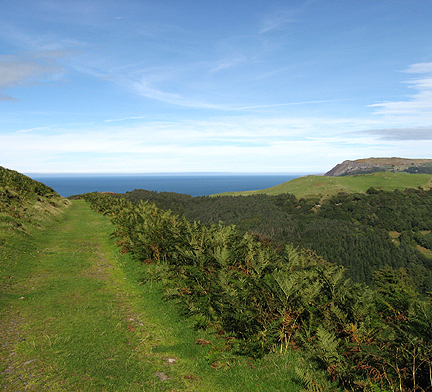
Timing a sojourn to Wales after an intense term of study turned out to be serendipitous. From the intricate, labyrinthine campuses and cloisters of Oxford, my steps alighted among the coastal mountains of Snowdonia. Very shortly after leaving my bags in the Noddfa house, I walked downhill through the village of Penmaenmawr, to the seashore. Immediately, I realized how soothing it was to be amidst wide open space. The same sensation struck me the following day, hiking in the mountains, and without thinking I swung my outstretched arms like windmill blades. The landscape, seascape, waves, and fresh air reminded me of home. A restful week-and-a-half in North Wales, following a profoundly scholarly experience at Oxford, drew me to savour the terrain, waterways, and skies.


These travels have taught me to treasure each step, each setting and encounter along this providential way. An old Bostonian named James Freeman Clarke once wrote about the cultivated habit of recognizing the miraculous and the beautiful as we navigate our lives. Using the example of a classic poet, Clarke pointed out how “Milton lived in London, but he saw more beauty in one morning’s walk in the country than many country people observe in all their lives.” (Conversely, it may require a country poet to notice the nuances of beauty in places like Boston and London!) But, indeed, a change of air and place can awaken our sense of appreciation for the elements we may otherwise take for granted in our worlds of routines. As I noticed details in the urban layout of Oxford, my impressions upon returning to Wales were equally enhanced. New terrain and the beaten track become intermingled. I remember an occasion, on a boat, when I described the islands near my home on Casco Bay, Maine, as the peaks of undersea mountains. It was simply noticing what was in front of my visitors and me. The terrain in North Wales is as eventful as it is varied, and my many steps sauntered streets, paths, and mountain trails.


enduring paces


Reflecting upon these sojourns, my thoughts mull the distinctions between lands navigated in a place such as Wales, compared to my forgettable workaday trudges. How are my steps and strides in various lands distinguished? After all, the paths are navigated by the same individual- the same pilgrim of trust on earth. The differences are in perception- and place. Granted, and quite obviously, a trail such as the road of the ancient Celtic pilgrims is many times more exotic and rarified than Cumberland Avenue. To be able to equally regard all earthly thoroughfares might require a strong sense of self-awareness combined with a disciplined spirit.


Similar to the old adage about the sea determining the substance of the mariner, the pilgrimage builds the integrity of the pilgrim soul. In turn, the pilgrim determines the worth of the long journey’s paces. An intensified significance especially applies when a sojourn is of our choosing. With every week’s paycheck, the first thing I do is tabulate how many earned-vacation hours I’ve accrued, and then divide that number by 8-hour days. It requires a month of full-time toil to earn a day-and-a-half of liberty. Time is bought at a price. Redeeming time which is at once longed for and cherished, as well as regretted and grieved, is a lifelong comparison. I’d do well to view these daily commutes and staff-meeting shufflings as though en route to the next mountaintop, around the next Neolithic standing boulder, or to the next wellspring. While trying to think of it that way, I hope to make my steps matter.


If our actions produce a memory or an effect that extends beyond our reach, then our steps do as well. Pilgrimages, by definition, are intentional travels to inspiring sources and alongside the very footsteps of our predecessors. In so doing, we generate impressions, making marks of our own. It is as though we contribute to the very achievements we seek to witness. There is increasingly more to remember, as time passes. A handful of small stones I’ve saved from the trails, and the words I wrote in transit, help to recall memorable places navigated. While captivated by the idea and action of motioning and reaching forward, I suddenly wonder who will be seeking our footsteps? Considering milestones and crossroads past, directions taken now have future implications. Travelling linear paths across ancient clearings, forests, and mountains broaden perspective. Our todays may surely meet with the todays of others whom we cannot know. The proverbial pearl of great price, as we know from holy writ, is not isolated without context, but is indeed found in a field. And it is a field we will leverage ourselves to gain.


Abergwyngregyn


proceeding


Through my explorations in Wales and nearby England, I listened to countless pleasant stories about travels to the U.S. It was good to hear about visits to Maine and other parts of New England, with admiration for our respective homes. As well, I was both surprised and heartwarmed at the exuberance about not just the city of New York, but about New Yorkers! A group in north Wales gave me their gleeful renditions of the New York accent, so I cranked mine up, and we all had a very loud time. Learning to attend, observe, and to notice what is around us, returning to James Freeman Clarke’s words, “changes time into life.” He described the skill of observation as a great art.

“Many of us pay half-attention to what we see and hear. Then we do not remember it. Travelling in new countries is useful as calling out the faculty of observation. The traveller feels it his business to notice everything, and often while abroad, is interested in what he has seen at home, but has not noticed it there.”


Along the History Walk, on the Bangor High Street.


The paces of time surely cannot be rewound like a mechanical watch, or turned back by paging through an old calendar. There is an important difference between attentively walking, compared to smothering the terra firma. Awareness is to conscientiously pace oneself. Physical motion looks all the same to the casual observer, yet the intention is as incongruent as arranging a dinner place-setting is from throwing a fragile artifact against a cement floor. We can boorishly bellow, or we can speak and attend with respect. Both require words. The distinction is in the spirit and the delivery.


I hope very much to return to Wales, not just to explore new corners and coasts, but also to revisit familiar places. The mountains and hills of Snowdonia will always compel and console. The trails with the best views tend to be the steepest pinches of shoulder-width divots between sharp rocks. Consequently, angular descents compressed my toes into the fronts of my shoes. (For relief, I occasionally descended by walking backwards.) Navigating the notches is entirely worthwhile, with each vista cherished. The way of broadened wonder is paradoxically one that is narrowly focused.


Isle of Anglesey


Walking the land in this pilgrimage of trust on earth lasts the length of life. Newly-found trails are combined with repeated paths. At times, I’ve made opportunities to re-walk the routes that are dearest to me. On other and rare occasions my steps intentionally overlapped past impressions in order to verify and change them. What should I have done that I failed to do? What can be corrected, and redeemed into time? Is the distance ahead worthy of the distance behind- even exceeding it?


Our adventures teach us how to proceed. Among other things, I’ve learned about how an action such as sojourning finds its distinction in its very intent, the spirit beneath the action. Just as a pilgrim can sense the ambiance of a place, so can the ground feel human intention. Seeking the solace of the fair country, I have surely tasted that solace.