Wednesday, April 17, 2013

wishes wanting


“I prize the cloudy, tearing sky
for the thoughts that flap and fly.
For staying in and reading by.
For sitting under.

This is a day for hearing bagpipes
somewhere playing.
This is a day for hearing sarabands
and hiding away.”

~ The Innocence Mission, And Hiding Away


Writing, when as a quiet verbal witness to each day’s living, bears some valuable review. If our written lines parallel the course charted by personal experience, then a functional archive is subtly being constructed. That archivist’s sense, abiding on and off the job, continually reminds me of the vitality of authentic documentation. An archival document needn’t be of any particular age, neither should it originate from any particular quantity of material. Of far greater importance in manuscript records is their authenticity and connection to their provenance- or source. Our most honest and accurate documentation can reveal actions and emphases. A study of documentation strengthens comprehension and informs present and future.


Within the context of narrative documentation, journal-writing finds its place. After all, for personal journals to be effective, the writing must be honest and as uncensored as possible. Whether an entry takes the form of a task list, a clipped criticism, or a lengthy reflection, the writing stands as a recording of a thought process at a specific time. Several years ago, I began the regular practice of indicating the time of day, as well as the date, of each journal entry. The tones of writing will differ from 6am to 10pm. Preserved thoughts belong as much to their author as to their time of writing. Having made these observations, I must add that I surely spend far more time writing than reading my journal entries. Yet as life’s rhythm warrants, I’ll remember my noted thoughts as both sounding-board and mirror to my state of affairs. Realizations tend to form and solidify between intense stretches of time, when there are bits of space to make notes. Being in full-time service to employment, I’ve long found ways to own thin slivers of my own time for the cause of creativity. Of late, I find that I must interrupt myself so that I can write what must be documented. Of late, as well, I’ve noticed quite a lot of enumerated frustrations. I occurred to me that in my daily written musings, wishes are left wanting. There isn’t enough wishing going on. At least, not as usual.


remember


Informed by my own archival record, I was able to see my own aspiration deficit. Along my persistent quest for what I need to know, I found myself reaching through some matters I’d already acknowledged in writing. Often, I hear myself say that “I want to know what I don’t know.” What is being overlooked? There must surely be explanations for my lack of success, yet in spite of that, through a combination of the air and light of early spring I saw the absence of wishes in my words. This is to say hopes, wishes, aspirations; essentially an active transcending of earthbound limitations. And thus, a distinction between the longings of the spirit and material ambition arises. As much as the latter aspect remains a motivation, I found the former neglected and unfocused in recent months’ entries. With my attention drawn, while writing under windblown skies, it was evident to me that we are prone to prevent ourselves from aspiring beyond today’s trenches.


A wise friend once advised that, given the choice, it is preferable to “write what you want to write, not what you have to write.” Often, in my mind, the two are the same, but the context of our banter had to do with the idea that repeatedly writing about abiding troubles may not be the most enjoyable thing with which to be occupied. Well, indeed, and duly noted. Writing about the uncontrollables runs its course, and a world of prospects must follow suit. So, I set about trying to articulate my wishes. Easier said than done. Day followed day, with the final task at my desk being a procrastinated, unwritten list. This is supposed to be easy to do- especially for a dreamer. Finally, my journal entries began to include wishes for places to go, and ways to be. My wonder turned from an incredulity at the absence of wishes, to yet another puzzlement at my reluctance to articulate wishes. With some pencil-twisting, I returned to recording some wishes, some aspirations with hopes of fulfillment. Some were smaller and simpler, to balance the hopes for better days, fruits of persistent labors, that aspirations may come to actuality. My experience has been to aspire and then to act. Yet, a beginning comprises the speaking forth of wishes- even in simple written words, or in wordless prayer.


aspire


In this gradual learning, across trackless time, the appreciating value of self-discipline cannot be overestimated. Part of that is to pray unceasingly, and not lose sight of wishing. Arid and dark deserted stretches must be lit by hopes. Paths and chambers are to be decorated with found eloquence. While trying to determine the controllable elements within reach, there remains great worth in wishing irrationally. Pascal once commented that wisdom sends us to childhood. He was quite right. Children are generally the ones preoccupied with trusting wish-lists, fantastic stories, and magic. I must know to not distance myself from such virtues. Respect and love toward neighbor as to oneself must surely also mean wishing goodness to oneself equally as wishing the best for neighbors. Wish for goodness, and do so with irrational generosity.


To aspire is to reach from the depths of memory, as well as against its tidal currents. The reach requires strength, as well as ability to distinguish matters of past, future, and present. When hopes are hindered by leaning back upon past events and notions, it becomes too easy to become entangled by incomplete histories. Past unsolved matters remain too close to the forefronts of thoughts. When wishes fixate exclusively upon the future, it is a revolving meander into air-wrought castles that neglects today. But the present, inadequate as it may be, does provide crossroads for memory conduits and future prospects. Temporal links such as intersections and highway ramps are inherently transitional and liminal. These are not dwelling places. Temporary passes permit for the collecting of thoughts. Incongruence can be rerouted from embittering to emboldening, as discontent fuels the reach forward. And in that sense of direction there must be a grounding in the immediate, a tending of rooted plants of this day. Progress, as it presently appears to me, indicates a composting of past to fuel future efforts. The ongoing written record continues in its role as creative witness, and as my evolving cartographic documentation. Fulfillment remains to be written. Or perhaps it is slowly forming, and cannot be seen in this present perspective. Nevertheless, with instruments and pages at the ready, the pilgrim scribe attends.


Tuesday, April 2, 2013

typosphere cheer


1969.

"The human mind, itself invisible,
becomes visible or manifest in words,
and writing, and gestures."


~ Frederick Copleston, A History of Philosophy, v.2.


The lengthened light of spring establishes itself once again. Fresh seasons turn the wheels of writers, return carriages recharged, prime platens, and calibrate keys anew, as we seek greater escapements into rejuvenating journeys. Economics, politics, and popular culture are no better than they were last month, yet somehow hope springs eternal. Defeat is mysteriously negated beneath fresh green baseball lawns. Flagging energies rekindle in such ocean winds as those which flog the Maine coast today. Renewed expectations become less our testaments of struggle, and rather causes for our optimism. And for the cause of encouragement, here are some images which have not seen light of day in a very long time- some not ever- to inspire you to shine up your writing instruments and train your springs through your own spring training. Archival documentation reminds us of souls who’ve gone before us.

Recently, I completed a thorough archival survey of approximately seventy years of newspaper photographic negatives. Woven around and through my daily work duties, and using every bank holiday, it took slightly over three years for me to review an estimated 1.2 million negatives. It was a rescue effort, as the huge collection was nearly discarded in a building-emptying corporate downsize. The project for me has been an adventure filled with wonder and fascination. Amidst dust, rust, and acrid acetic acid odors, I’ve witnessed my home region’s twentieth century in silver cellulose. Crates and rotted cabinets filled with disorganized film is now under control and being indexed for conservation and future studies. Out of chaos comes order. This experience of perseverance and accomplishment will always accompany my thoughts, and I’ve gratefully combined my photographic roots with my archivist’s sense. Readers of these pages may remember graphite archive, which incorporated pencil-writing images I discovered as I made my way through the collection. The decades illustrated in these negatives also comprised numerous images of typewriters, and indeed I indexed these, too. The same eyes that could recognize a pencil in a subject’s hands in the reverse image of a photo negative could also identify the presence of a typewriter. Still photographs potentially offer immense amounts of information about their respective context.

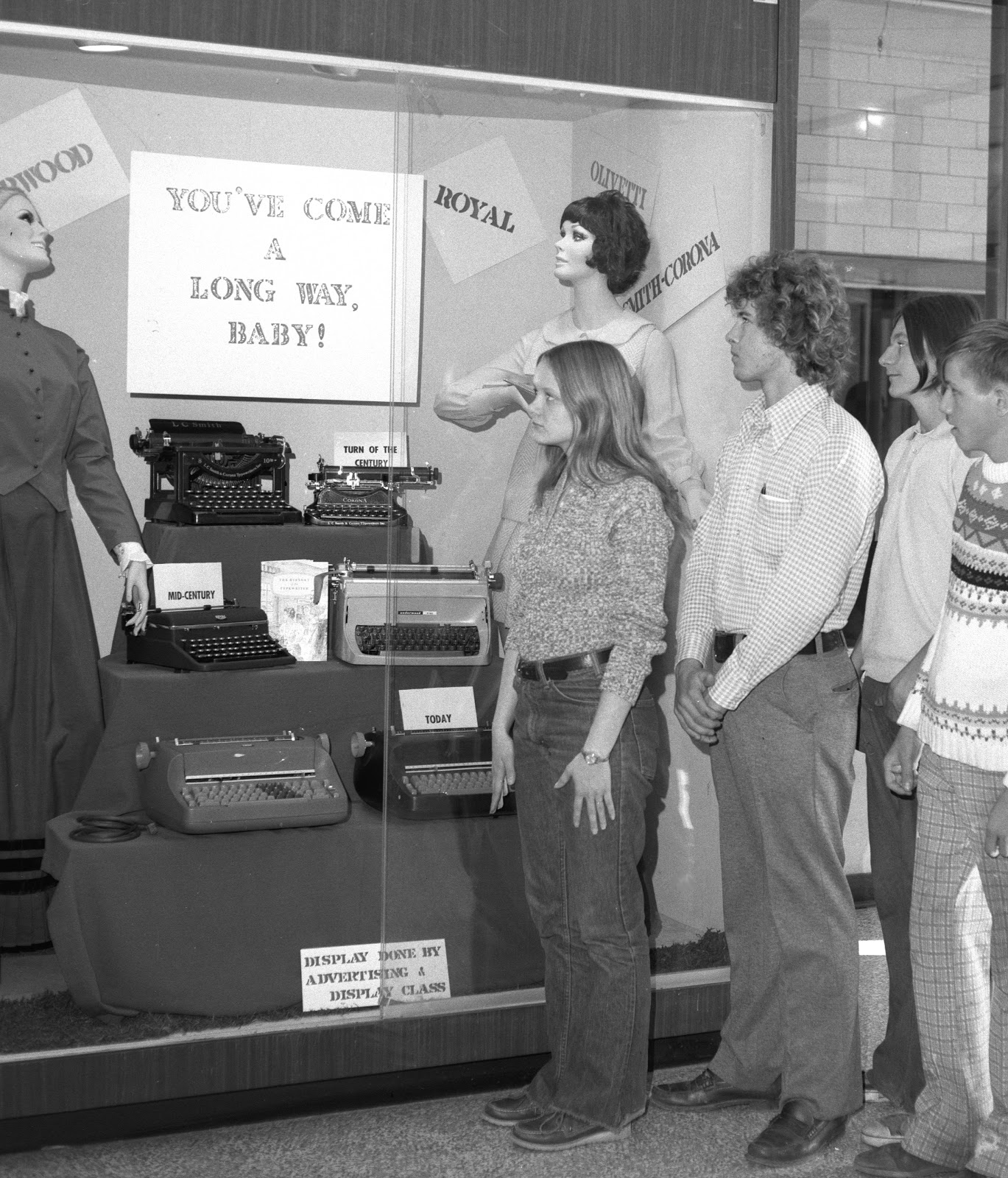
As many of us already know, typewriters are extraordinary motifs for photography. The machines themselves are far from being impersonal mechanical contraptions. Typewriter owners have always tended to make the machines their own, thus extending personal touches through instruments sensitive to the human touch. Even typestyles and sizes vary among the varieties of machines and their epochs. When you observe this selection of photographs, notice how people and their typewriters are pictured together. Authors and their machines appear parallel to concert pianists and their particular expressive instruments. Every student and professional needed a typewriter; these tools were especially required in order to compose correspondence, submit polished reports, scripts, and to finalize projects. Notice the vitality of typewriters in offices, personal studies, schools, and on chemists’ countertops. Typewriters continue to be instruments for creative writers. From the machines themselves, notice the sampling of environments- in this case, it is northern New England from the late 1930s through the early 1980s. Look at the typewriters’ habitats, along with those of the writers themselves (this essay can also be viewed as a slide show).

Having so many indexed images to present, I chose to categorize them in this essay by the uses of typewriters by students, professionals, creative writers and authors, and in places of procurement. The latter category refers to the need for supply sources for typists’ commodities and places for repair. Consider the parallels with automobile showrooms and garages, and contemporary bicycle shops. Here’s to the Typosphere, those who straddle the ether of the internet with the solidity of their cherished Olympias, Underwoods, Olivettis, Smith-Coronas, Royals, Adlers, and on and on, persevering with the passion (and shoulders) required to produce bold marks on a manual platen. Cheers to the ‘spheres!


at school

1937.


1955.


1960.


1975.


Above: Students at Southern Maine Vocational Technical Institute (SMCC, today), in 1974.


Westbrook College students, 1968.


at work

1942.


1982.


1947.


1948.


1944.


Detective studying a fingerprint, 1958.


1959.


1959.


1962.


1968.


1976.


Retirement party, complete with new typewriter and a tasty lobster wrapped in a ribbon, 1962. Only in Maine!


creativity

1979.


1948.


1940.


1981.


Top: 1947; Bottom: 1944.


1957.


1949.


Historian A.A. Hoehling, 1959.


1973.


1974.


sources

Underwood and Smith-Corona stores were on Federal Street, in downtown Portland. Top: 1940; Bottom: 1942.


At Royal Typewriter store, on Exchange Street, Portland, 1948.


1965.


1965.


Roberts Office Supply, was on Middle Street, Portland, 1973.


Wigon Office Supply, in 1966. Still in business, and still on Free Street, Portland. Wigon's still sells typewriter ribbons.
_____________________________________________________

1976.


Thursday, March 21, 2013

the society of books


“These momentary chances we covet, and spend our years
and passions and powers in pursuit of little more than these;
while meantime there is a society continually open to us...
lingering patiently, not to grant audience but to gain it,
in those plainly furnished and narrow anterooms,
our bookcase shelves!”


~ John Ruskin, The Society of Books, from Of King’s Treasuries.


refuge in motion

Along the pilgrimage, this lifelong voyage turning with earth’s curvature, I’m occasionally able to find intermittent respite. Retreats I’ve discovered along the way have become my hospitable way-stations. But halting the paces of obligations and survival demands is both rare and earned through extraordinary strain. And although my returns to the fray are often hard landings between contrasting situations, the retreats continue to be enormously worthwhile. Years of intermissions cultivate enduring touchstones to inspire daily enterprises and illuminate roads ahead. Experiences provide reminders, yet I’ve still to refine a skill of translating healthful ambience from retreats to workaday life. At the same time, I recognize some inherent dissonance between spiritual priorities and market-driven motivation. The individual soul must invariably choose which master to serve.


This time, the spans without respite draw my interest. Arid stretches of unknown duration, paralleled by constant and vigilant striving, are surely times during which a consistent awareness of sanctity is vital. Finding refuge while in motion, without being able to sufficiently stop, is the challenge. During a recent lunch break, I looked to the skies and thought about long haul aircraft that refuel while airborne. Then I remembered my training in art education, being taught to provide “in-process reinforcement.” With every subject I’ve taught, to this day, the value of checking by conversational reinforcing that a new concept is understood has more than proven its worth. Recalling these ideas caused me to consider refining a presence of mind that can better reinforce in process, that can maintain fuel levels, even when respite time cannot be procured. Thoughts of refuge returned to me the other day, while ensconced aboard a Boston subway train; recharging while in motion. I had been listening to inspiring music, during my transit to visit libraries and friends. Transit provides productive moments for written reflection.


liminal


Ordinarily, the concept of liminal space is associated with brief, transitional times; short spans between stages. Threshold lengths amidst broader adventures along a soul’s pilgrimage of trust constitute the liminal connectors. It is expected that- once noticed- a space between pursuits or phases of life will be short-lived. And what if they aren’t? How long before liminal becomes an indefinite way of being? How permanent is temporary, and how temporary is what we assume to be permanent? Perhaps the present is a protracted exercise in my learned perception of time. While feverishly wondering how I can hasten my fortunes, I also question the very sense of the course of my pursuits. How far along the way is too far to make another career change? Closed doors and expired opportunities abound. But surely, there must be open lanes. My thoughts circle back to whether I’ve been missing something that I should’ve long known. Perhaps a lack of common sense, or perhaps a lack of jadedness, all of which remains to be seen.


Indeed, part of attempting to comprehend the liminal present is imagining how I will look back upon these times. Through such trials, no matter their duration, there remains an incorruptible assurance, even though it neither pays my bills nor releases me from indignities. Well aware of his life-sentence, albeit as an innocent prisoner of conscience, the ancient Boethius composed his immortal Consolations of Philosophy. In spite of his conditions, he insisted that God is the objective, transcending, enduring good, who does not give up on us, no matter the extremities our emotions can twist us into accepting. My readings in the old, familiar Consolations tend to begin in Book 4, in which Boethius has become well acquainted with the majestic Lady Philosophy, and their dialogue proceeds to address the importance of trusting faith. In this, he observes how even our unhappiness can be of use to humankind and to our understanding of divine grace. Revisiting these readings spoke to my musings of what is reliable in the fluid and abiding present: enduring words and the Spirit upholding them.


books and words


One night last week, following yet another exhausting day, I chose to read instead of write. Too much space in my journals had been given to enumerating frustrations. From my small desk, I turned to the shelves of old friends conveniently adjacent to my perch. Purposefully, my choices favored life-giving and thought-provoking words. Pascal, Aquinas, Merton, the Bible, Brother Roger of TaizĂ©, and two small books called Great Companions. The latter title was drawn from Walt Whitman’s poetic beckoning to seek out the great companions and belong to them. The books’ contents comprise numerous “readings on the meaning and conduct of life from ancient and modern sources.” Published by the Beacon Press, on Boston’s Mount Vernon Street, Volume I was first printed in 1927, and Volume II in 1941. The books in themselves are great companions to me, both as destinations and as launches into further studies of the selections’ sources.


The Beacon Press, Boston.


Quite naturally, yet still a soothing surprise, I reached for the kindredship and consolation of words. When writing runs dry, or is cast adrift, it is a reminder to read more consistently. Replenishment is as productive as the coverage of distances. My gratitude for reading brought to mind that as the individual is an earthen vessel carrying the gift of God, so the books at my reach are rafts of composed words. The great companions in cherished readings are at once consolations and distractions. With that in mind, I decided to awake before dawn on my day off, and go to Boston. One of my favorite things to do at the Athenaeum library is to set a chair in the aisle of “Cutter 3's and 4's,” and seek out gems at random. Never a disappointment; always new pearls. Having opened windows from my closed thoughts, I can inhabit the ministrations imprinted carefully upon the pages before me.


From Cassiodorus, to Plato’s trinity of Spirit, Reason, and Memory, I proceeded to the classic sermons of Phillips Brooks. An illustrious Boston cleric of the 19th century, Brooks wrote of the human craving for Continuity, Variety, Influence, and Reality. All my readings combined to remind me of heavenward aspirations. These ideas and statements represent messengers of grandeur, expanding perception, and transcending the temporal. Leaving my perch in the Athenaeum library aisle, I walked across downtown to Copley Square, remembering the Phillips Brooks statue near Trinity Church. The broad piazza is flanked by the large church and the flagship Boston Public Library. Visiting the church also permits for a stop into the Great Reading Room which was filled with pensive souls. The readers, and reading in itself, reminded me of the innumerable great companions ever in my midst. A sense of wonder is indeed a sign that indicates one’s progress along life’s pilgrimage. In agreement, Phillips Brooks, in his On Promoting Spiritual Life (1893) adds:
“Wherever there is a wonder, we are sure that if we listen with our hearts we shall hear, out of the depth of that mystery, some richer teaching, some large revelation of God’s truths.”


"My service, my true will-dedication
ought to bring me out into the light; at least I will remember that.
I will not be content with darkness.
I will not let despair of positive belief settle down on me with its chilling power."

~ Phillips Brooks, "The Withheld Completions of Life"


Trinity Church, Boston.