Showing posts with label living history. Show all posts

Thursday, July 26, 2012

rhown garreg ar garreg


“Before the horn of summer caught the tune
Born in the shell of grief. The velvet bone
Of sea-weed forests melted in the noon
And every frond bent down to clasp the stone.”

~ Idris Davies, Sonnet


Sojourning through various regions of Wales, becoming accustomed to landscape and light, my attention was consistently drawn toward the ancient. Antiquity and modernity live alongside one another, often superimposed. Town centers have castles and cathedrals at their hearts, sending forth roads from sites of mediaeval market places. Noticing many stone structures, along with natural formations, and megaliths, it is a marvel to consider their histories. Whether walking along the highest edges of castle walls, or weaving my steps within circles of large standing stones, my imaginings meandered with “what people and times these places have seen!” Sculpted and chiseled blocks were quarried, hauled, and fashioned by many human hands. By their very presence, megalithic boulders and cairns are mysteries. Encountering these sentries, we are left to wonder at their ages and purposes.


Often the hillside stone houses and rugged towers appear to emerge as extensions of the landscape as consistently as the seacliffs themselves. The earth’s very composition is everpresent as it manifests in slate, granite, and soil. On the occasions I’d navigate raindrenched trails, I experienced the terrain attaching itself to me. “God breathed on the clay,” Tozer once said, “and it became humanity; and as the Holy Spirit wafts through us, we become clay.” Simultaneous with my fascination regarding the assemblages of massive stone structures, and with the ancient groupings of enormous dolmens, is to ponder the presence of ancient witnesses in these times. Indeed, there are older antiquities extant- not just in Wales, but in other parts of the world. Yet in these examples, among the stories and memories of densely earthen forms, the past journeys to the present.


From my bead in the time abacus, I am able to freely walk amidst mediaeval royal courts and around ancient ritual sites. With pencil, notebook, and camera, my explorations were abetted by flexible modern shoes. My perceptions had been trained in another hemisphere, a wide ocean crossing away. The ancient intentions of these structures have come to absorb contemporary views and purposes. Their builders and residents may not have imagined the stone edifices were destined to become monuments along paved roads or streets. Further still, any person of any background or social standing can enter. Visiting castles on weekdays, there was plenty of silence and space, allowing for countless writing perches and unobstructed vistas.


Druidic stone circle, Bangor.


The megaliths and cairns appear sturdy, calm, and majestically indifferent. They seem to elude the idea of defeat. And yet, I am simply one of countless pilgrims that arrive to see these places and view the world from their vantage points. In my gratitude, I savored the time for writing in these places and being able to listen to the elements.


Conwy


Views from atop the walls of Conwy


Conwy represents an example of a castellated town. The turretted castle stands on solid rock at the peninsula-like eastern corner of the walled town which is also encompassed within its built perimeters. To enter Conwy’s town center (as the town has surely grown beyond the mediaeval walls), it is necessary to pass through an arched stone castle gate. It is said that more than 1500 builders and stone-cutters built these structures in the late-13th century. The town church, at the center, dates back to the 12th century. The ancient is very much alive- in creative ways. On the morning I walked the castle grounds and towers, a group of schoolchildren had been busily writing their assignments while seated in the drawbridge area. One of the castellated town walls has a café built into it, not surprisingly called the Tower Coffee House.


Above: Tower Coffee House.
Below: A Conwy street.


Above: A public bus passing through a Conwy gate.
Below images: Essentials within the town's walls: Public Library, bakery, and post office.


Walking the Conwy perimeters, up high atop the walls, there are sweeping views of both town and distant region. Some sections of the walls serve as places to store backyard furniture, and vehicles have to take turns passing through narrow arches in the walls. A parish church uses contiguous sections of the walls for its Stations of the Cross. The relief sculptures are striking in their contexts.


Cefn Bryn


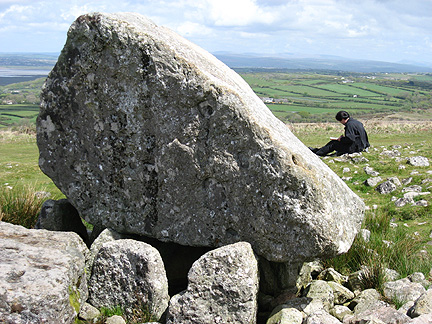
Cefn Bryn is a broad ridge on the Gower peninsula, upon which is the neolithic Arthur’s Stone. This enormous glacial boulder is a cromlech dating back to approximately 2500 BC. The popular legend, as it was explained to me, is about King Arthur walking along the shores of Carmarthen Bay. Irritated by a pebble in his sandal, he threw it across the water and it landed in the form of the boulder on Cefn Bryn. The site had been used for ceremonies beginning in the Bronze Age. Arthur’s Stone is massive, and can be seen from far away, standing by itself on its elevated plain. Walking around it, I was fascinated to see how it mysteriously stands on several smaller upright rocks with a freshwater spring underneath. Though I was there on a windswept afternoon, the sides of Arthur’s Stone were warm to the touch. The view from the cromlech, toward the ridge’s descent to Carmarthen, is as impressive as the Stone’s site itself. I made sure to spend time writing there, though simply looking at the scenery was much more captivating.




That we are drawn to motion ourselves in one direction or another, through great distances or short errands, is itself a mystery we uniquely possess. We tend to refer to a path as “leading us,” but more likely compelling intentions are what drive the soul to take to the trails that lead our steps. Deep within is a continuous urge to strive toward the sites and sources of our hopes. To castle, cromlech, and crag, my paces respond to structures formed from earthen elements. Stone upon stone, garreg ar garreg, the present displays the historic, and the human soul strengthens.


My travels have been training me to carefully listen to ancestral wisdom. What stories do the ancients convey, and are there words to the message? In specific places in Wales, especially those of my mother’s memories, I collected a few small stones and seashells as artifactual reminders. I also brought along shells from Maine to leave in various places, and along with larger gifts to Welsh friends. At the dolmen bearing the name of King Arthur, I did not wish to take even the smallest fragment. Rather, I placed a bright Maine scallop shell into the springfed pool beneath. Casco Bay is a long way from Carmarthen Bay, yet my modestly mortal steps represented the traversal. The words from the stones-upon-stones are to reverence and remember.


A seashell from Maine descending into the pool beneath the cromlech, King Arthur's Stone.


Through cairns and castle keeps, I’d imagine myself in these places when they were not viewed as monuments. What would I have done in a world so different? Then I thought of my 21st century self visiting castles and places like Cefn Bryn, and how we would all perceive one another. As a soul explores a site, the element of time becomes a fulcrum point. While travelling physical distances, then continually transforms into now. In voyages of absorbing the historic, we continue pacing into the future.


("Rhown garreg ar garreg," is a line in a Welsh folk song, meaning "we'll put stone upon stone.")

Monday, November 14, 2011

brave


“Oh I know it, I know it, here is God beside.
I meant it. I meant I’m sure of that.
But the sky is tall and heavy,
when I could be brave.
Brave.”

~ The Innocence Mission, Brave.


The enormous housing project in these photos, which I’ve just made, show the place that nobody in my family will talk about. Our eight years there coincided with New York’s darkest years of urban decay and violent crime. Those eight years spanned age 5 to age 13 of my life. As I transitioned from elementary into junior high school, as a ten year old, the neighborhood’s quality of life had deteriorated into a ceaselessly nightmarish world of uncontrollable hostility. Today’s city, even with its present problems, is a world away from the war zone years of the late-‘70s and ‘80s. Life as a young child amidst America’s largest privately-owned housing project was one of tense attempts at survival. Within the 20 high-rise towers of 18 storeys each, comprising more than 16,000 residents in more than 5,000 apartments on 42 acres- are countless alleys, stairwells, elevators, garages, twisting corridors, and basements. Vivid memories of menacing dangers, being pursued, beaten up, and mugged in that monstrous project seamlessly intertwine with my parallel experiences in the district’s streets and schools to which I had been bound.


After my parents finally moved us out to a safe neighborhood, none of us ever returned to Corona. We did not talk about it, either. Going on to high school and young adulthood in Manhattan, I had plenty of immediate concerns. I also fulfilled the promised I made to myself to leave the city in favor of peaceful shores. Yet for many years- regardless of distance or age- those crepuscular labyrinthine hallways and cement trenches, along with lingering recollections of helpless subjection to merciless thugs- continued to violate my thoughts. Wishing for these cyclical nightmares to end, I began to ponder an extraordinary pilgrimage. Aware of the potential of words and images toward healing, it became a pressing necessity to see what these places would look like now. Now, as an adult; now in the post-Guiliani law-and-order New York of what I call The New Maintenance; now with notebook, camera, and car. Suddenly, I dreamed of visiting the places of so many nightmares. I needed simply to see.


My walks to and from school still look the same as they did years ago. Imagine this at night.


It became increasingly necessary to go, so that I could see how present buries past. Years ago, I met a Mennonite pastor who described a great metaphor to me. His family farmed wild rice in the upper Midwest, and they intuitively knew precisely when to harvest. This was based upon weather, humidity, and factors they could sense- even at night- and the harvest needed to be prompt and swift. He called this “wild rice time,” and indeed there was a theological application to his expression. Making this particular travel, not just to New York but to revisit the high-rise project, found its “wild rice time.” Musing was not enough. My pilgrim steps longed to recover those left behind long ago. There were deep imprints to verify as well as to dissolve into the mists of obsolescence.


With the approval of my time-off request from work, I arranged a visit at my elementary school, and proceeded to prepare for the historic portion of this journey. Anticipating associated emotions, I planned the tough parts for the first day, with a week of city favorites and comforts to follow. This proved to be a good idea, as thoughts of seeing the streets and buildings of Corona haunted me into insomnia. I was able to tell myself that art museums, good food, and pleasant neighborhoods would reward. Before setting forth from Maine, I gathered seashells and decided I would scatter them in each of the important childhood places. Somehow this added more purpose to this strange pilgrimage. Tiny fragments from my home of choice have been left in the places I’ve survived.


Portland, Maine(above), my elementary school yard, New York City (below).


Counting down to the journey steadily unnerved and distracted me. It was as though a mental journey preceded the physical one. Very late one night, I tuned my radio to a broadcast in which a preacher quoted the biblical Paul’s advice to Timothy, his student, with a reminder that the Spirit of God is not one of fear but rather of strength, compassion, and a sound mind. Fear must not paralyze. My journal entries began describing what I called a “crumple zone” of hesitation, and a “Crucible Monday” to be endured- and with that I stopped writing and set aside the journal for several days. “Buildings and streets,” I heard myself say; “these are just buildings and streets.” The memories are not there. Though I can put them there, I can also erase them from present and future pages. It’s graphite. Yes, this called for bravery, but it seemed the greater courage was in the decision to set forth and fulfill- even more than the bravery to walk the pavement. Standing down the nightmares began with prayers, and somewhere between the highway voyage and parking the car with camera and seashells in hand, things had already changed.


Above: My junior high school, I.S. 61, at right.


As anticipated, the massive housing complex looks as unwieldy as ever, but enough years of neglect and street crime evoke a general sense of shopworn weariness. The surrounding streets are startlingly narrow and congested. Iron bars cover more than just ground-floor windows, doors, and driveways, but even upper-floor windows and balconies. Inhabitants’ gazes from windows must be filtered by wrought iron bars. This is the polar opposite of life in northern New England. Rather than to see the streets and buildings as evil, I could only feel a respectful empathy for children whose early impressions of the world must happen though barricades cemented into pitted streets. But I was thankful to be there to see everything- and for an elementary school visit that was joyous beyond my expectation. That is for another essay. Past horrors have been converted into my gratitude and a recognition of goodness. With this visit, recognizing everything I’d remembered, I could also identify the changes in these places and within myself. It was an experience of corroboration- with teachers who remember what kids like me had gone through- and contrast; of distant memory and greeting the here-and-now classroom children. My prayers are with those who struggle in crowded schools, dangerous housing projects, and through iron bars. And for those who survive, interior reconciliation and the dissolution of fears.


Below: I.S. 61 schoolyard.


Now at home, I took the first opportunity to walk across Portland to a favorite perch on the Maine State Pier. Bracing air, clear skies, circling seabirds, and old friends remind me that I’m back. Pilgrimages historically always include the return travel and the re-establishment. That is because no matter the journey, pilgrims return as changed souls proceeding to reconcile road and routine. I know that I saw more than “buildings and streets.” But today, as I write these words shortly after unpacking car and bags, I am still in the aftermath. Throughout this past week in New York, words gradually surfaced and with a small notebook I jotted them down in the subway. A couple of mornings ago, on an E train, I pencilled, “even if I’m not home yet, I’m already on the other side of this.” That night, after a full day of visiting, walking, errands, and photographing, I awakened from an unusually deep sleep, and wrote down some words: “3:20am - the closure is in realizing that what lived on so vividly in my memory is no longer going on.” To say “not going on anymore” is to deeply recognize how the chaff of bygone years ceases to exist; fears cannot dominate when they are superceded. Such proofs must be lived, it seems I’ve just done that, and will continue to proceed.


Thursday, November 3, 2011

living history, part 2


“History teaches everything,
including the future.”


~ Alphonse de Lamartine


(Upper 2 photos- le Château de Cormatin, Burgundy - France:
the author Alphonse de Lamartine's retreat.)


At the intersection of living and livelihood, walking and working cross-pollinate. The logistics we experience daily that run our businesses and institutions can even affect our household routines. One day, after years in the photo business, I noticed how much my kitchen and my darkroom (on opposite sides of town) resembled each other. I fold my laundry in the same way I folded clothes in a factory I once worked in, and my efficiency as a prep cook resembles a food service job I had while in school. Academics, teaching, and archival work influence how I read. My favorite books are equipped with my own crafted indexes. I’ve rebound many of my books to make them sturdier. While awakening others to the study of history, I’m stoking my own studying fires, well aware of the value of historic research. And reflection, contemplation, along the voyage of faith. How does this continuum known as the pilgrimage of trust on earth appear through an archivist’s eyes? The ancient psalmist, in his searching of God’s vastness, prayed “search me and know my heart.” He inquired to be sought. In this sense, to research is to verify, to confirm, and to strengthen: Confirmet cor tuum. At this prospect, there is always energy to continue learning and preserving truths to heart.


Just this week, I’ve completed another round of teaching the conservation of books. Another class filled with animated learners. Now in my 12th year in preservation education, it interests me to consider how these topics continue to be so popular. The latter 19th century and early 20th saw an enormous proliferation of documentation and publication, albeit upon largely embrittling material. Thus, there is plenty to preserve- in their original, assuredly readable forms. These primary artifacts will continue to be sought after, as evidentiary records that can be authenticated. Archives are as informative as they are evidence- of lives lived, of commerce, of transit. Those of us that journal are creating an archival continuum. We want our testaments to last; we want what we love to be permanent and known. And we collect. One of my current projects involves processing an author’s archives. Unpacking his boxes, I saw that he saved his licence plates, and filed them along with his passports and military medals. Along with a belief that we naturally seek our origins, I think we are all collectors. Most everyone loves to collect, in various ways, and have others admire what they cherish. At the same time, I see how many reach the point at which they desire to give what is cherished, so it will be preserved- with the narrative context that gives significance to substance. For an archivist, it is the transferral of provenance; in more human terms, we become living witnesses for one another. Which tattered tomes are worth our resources to preserve?


(A retired history teacher gave me this beautiful typewriter which he used throughout his career.)


In some profound ways, the first day of my graduate education initiated the rest of my life. My road to a double-majored masters began with an after-work evening course. Dr. Cole looked at all of us and said, “Why study history?” Getting everyone’s attention, he continued with, “If anything, study history for personal development.” Of course, I wrote this down in my notebook. We were taught from the standpoint that , “there is no phenomenon without history,” and that by organizing facts and events, narratives emerge that meaningfully inform. Historiography explores the uses of the past, whether that means civilizations, battles, philosophical thought, or one’s very life. An awareness of history’s importance is one thing, but it’s quite another to elucidate why some elements of the past continue to matter. It interests me to consider why we relight lamps long languished in storage, and what treasures are sought in the search. What brings a soul to reflect upon that which no longer exists- or upon something that continues albeit in a barely recognizable form? Probing the past must not fall into the trap of dwelling upon it. Contemplative searching leads to an understanding of what is at one’s threshold.

With journaling as historic writing, it is possible to identify instances in which I’ve altered a course in light of past lessons learned. Any knowledge can be proven, as questions are posed of its findings. Consider past circumstances from which to steer clear. Think of the good habits and attributes to build upon. Weigh the worthwhile things that currently exist. Hoping not to repeat old mistakes, I equally hope not to be jaded by the lesser leftover impressions from affiliations, relationships, and expectations. How shall we live beyond our stories? How would we like today to be remembered? As the Holy Spirit breathes life and redeeming use into recollections, I become able to consider the good purpose in what I have so indelibly retained. But it is surely a discipline that demands exercise and care. As I prepare for future journeys, anticipating the merging of interior and exterior geographies, history compels me in a forward direction. What is past may be touched upon, though it is not to be gripped in favor of what tangibly and presently exists.


Thursday, October 27, 2011

living history, part 1


“The ancient language of faith can no longer be taken for granted.
Its terms must be re-examined, if their abiding significance
is to be understood.”


~ Evelyn Underhill, The Golden Sequence


With each day’s work, the unpredictable assortment of stories increases. And the queries, anecdotes, and observations come to me daily from the public I serve. Every person is welcomed, listen to, and helped according the information and research needed. Part of my role is to convert spectra of random queries into routes leading to sources of documentation. Conversational flows make these interactions smooth and efficient, and equally important to solving questions is speaking to patrons understandably and respectfully- whether they are 10 or 90, kindergarteners or thesis-writers, blurry or articulate in speech, news articles to manuscripts. Random as radio, I say, but occasionally during fresh-air breaks it is astonishing to notice unrelated yet common threads in the questions and stories I hear. Often the anecdotes are intense with irretrievable losses, wars, and missing relatives.


Everyone searches. Many ask for high school yearbooks, and it’s easy to guess the requested years correspond with their own times in high school. I witness how a soul can be swept into reverie by simply glancing at printed pages. “That’s where I lived,” say those who point to lines in an atlas, or a listing in a directory; and out pour the stories. It is a wonder to consider how written names and slivers of time in pictures and texts can animate thoughts. These are proofs of the realities we recall. Among the project-related researchers are numerous individuals looking for what their memories press upon them to retrace. Rolling through microfilm, most people seek obituaries to learn about their forebears. One man wanted to see what movies played in which theaters during a portion of his childhood. Another sought her grandmother’s beauty contest picture. One woman brought an envelope filled with tiny embrittled newsprint which, when assembled, amounted to a picture of a cabin- but without a date. I rebuilt the clipping on its verso side, and could discern a dateline on an article’s column- and found the full item in the corresponding films. Many people search for articles to be able to deal with the past. Some come looking for the car accidents and disasters they’d survived. Telling me he was finally ready to do this, a man sought out the name of a cyclist he’d accidentally fatally struck decades ago; he wept at the sight of the article.

There are also joyful discoveries among those who seek. And there are the rejuvenated artifacts: a woman brought in her great-grandfather’s diary which began its journey in Ireland, and I made a box especially for its preservation. A man brought in an old, tattered edition of “Uncle Wiggly,” and, like the woman with the diary, was elated with its repair. Another cherished story involved a Korean War veteran who brought me his memory book from the ship he served on. The book resembled a yearbook, and was filled with pictures, data, and the signatures of all his fellow sailors; it was also in very rough condition, and the binding was entirely broken. This man was en route to his reunion, and wanted to know who could fix the book. I told him to leave it with me and to come back the following day, because I took the book home and completely rebuilt it. The veteran’s reaction to the sight of the book on the next day was surely worth all the restorative work. I refused his offer to pay me, instead paying him his due respect. Well, a day later he returned once more with the gift of a new U.S.S. Maine crew cap for me. He was very grateful, and so was I. Witnessing the experiences of others, our own experience broadens. We can substantiate one another’s stories. The puzzle pieces become vital, but we must each determine those essential components that build bridges.


Though we naturally thirst for our origins, not everyone will make the effort. I get to help those who make the motion to discover. The desire to know, to find context, has driven many a pilgrimage. We want to make sense of our lives. Reckoning with the value and substance of personal history is a crossroads in itself. And though my place is not to judge, but to serve, there are overt differences between those who seek to find their roots and information to pass along- compared to those who use genealogies to prove various sorts of status. Lineage and nobility continue to captivate many. But indeed, no person can self-immortalize; identity is far more means than end. Embedded within our historic treasure are ways it can inform us. Reminders sensed in the present ignite distant memories. It is astonishing how the smallest and most obscure details hold their places through lives that intensify with complexity. We witness in one another a perpetual search for purpose to accompany remembrances and retained histories. Being our own archaeologists, care must be taken in excavating: how much of the present environment can stand to be disturbed, how much of what is past warrants our exploring, and which layers of substrata are best left buried? If it is in our nature to seek our sources, we are surely prone to do this selectively. Faithful historiography warns practitioners against revisionism, which is to say rewriting what had been with what hadn’t. My own fascination rotates between retained mysteries, lost chapters, and how the way forward is lit from the future while my steps are inspired from each of the eternities.