


 Posts
Posts


“My pen is not able to set forth
the solemn quiet awe, the calm,
serene state of mind that I enjoyed
for many days, so that it seemed
that I had gotten into another world.”
~ Memoirs and Journal of Hugh Judge, 18th century Quaker
We may well consider that moving through hours and days, connecting locations and occasions by our paths, a voyage of distances and way-stations has long been in progress. We need only to realize. There is a natural longing for safe havens, and these manifest in as many ways as we are individuals. Viewing the whole of living as a continuous pilgrimage, sanctuary may be found as easily in a café as in a cathedral. Opening my journal to write, during a hillside intermezzo, the book itself represented a shelter of worded thoughts. Pages already inscribed enshrine sanctified ideas and impressions. The subsequent blank pages to follow are as lands yet untracked. The recording of moments resides in the liminal, with freshly written lines shining back available light. Though not always conscious of our searches for places of tranquility, they are surely recognizable in our unguarded wonder.

Hardly able to believe I had reached the Pilgrims' Way- and North Wales- I made sure to do this.


Above two images and sculpted icon below: Saint David's Cathedral, Cardiff.

By definition, one may well think of high altars, congregational solemnities and ritual celebrations, but in general sanctuaries include places of refuge as well. Where refuge is found, tranquility, safety, and respite are discovered; these represent oases from such forces as those which exhaust and endanger the soul. Over the years, I’ve learned to seek out such locations and situations; they are vital and necessary. Sanctuaries are places conducive to strengthening, pointing wayfarers to reminders of God, of consolation, of the value in the voyage.

Above: Bible Garden, near Bangor Cathedral
Below: Bangor University Chapel.

A sanctuary may be perceived as something pulling the traveller off the road and interrupting progress. It may look to all the world like unproductive destinations, but indeed, I draw needed inspiration to retake the road undauntedly. Fresh starts are crucial, however they are tried in fresh continuances. Beginnings have their references in my continuum of terra cognita, but my journey’s end ever remains unknown to me. What I can and must do, is to hold the wise course of living faith.

Penmaenmawr


Above: The small chapel at right was used by the BBC for Dylan Thomas to broadcast his poems and essays, just far enough away from the bombings of Swansea harbor during World War II.
Life as an ongoing pilgrimage of trust provides context as I string together nurturing venues amidst the constancy of transition. It is a process of learning and growth. Times of retreat provide for places of strengthening, sending me into the stream again, so that I can face the world newly intact. With a mindset of sanctuary, large and unfamiliar spaces can become intimate, with reminders of the Holy Spirit’s presence.

Recently, while travelling by train, I looked up from my writing and coffee to look around at my environs. Passengers with their belongings, and rolling scenery through the windows, brought to mind how the train itself was a sheltering passage toward future places. Returning to the view from my window, my thoughts turned to what I call “discovered sanctuary,” which is how I describe the realization of being in a peaceful place- when sanctuary is found incidentally. Then, turning back to my journal, the book itself reminded me of its own intrinsic properties as a portable refuge.

Caernarfon Castle. The photo below is the site of the castle's chapel.
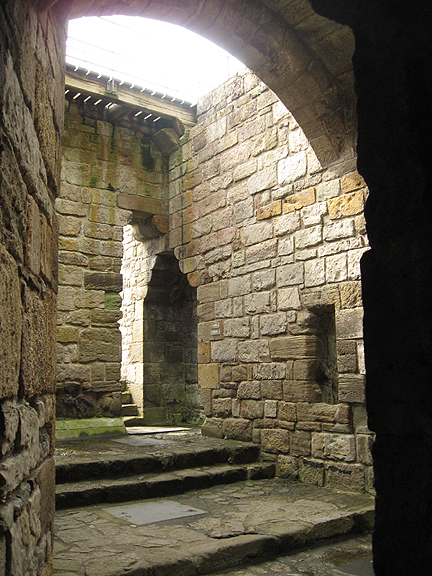
In Wales, my experience was very much an incidental succession of sanctuaries, no matter where I travelled- indoors and outdoors alike. My steps crossed thresholds of holy places, paths, and homes. Each encounter was wrapped around a sincere welcome, and I was sure to express my appreciation. My seatmate on a train in North Wales happened to be from the Isle of Anglesey. I asked him what his favorite peaceful place was, and he replied with the 6th century Penmon Priory; he described the “quiet presence” there, and how much he loves to walk the grounds. I followed his advice, grateful that I’d asked.

Penmon Priory, Isle of Anglesey. Yes, I was really there.

The hospitable openness to converse, which I found everywhere, brought my steps to sacred sites I may not have easily found. Fellow pilgrims I met along the way pointed out where I could find stone circles and cairns.

Ancient cairns, Carmarthenshire.

Circle of standing stones, Bangor.

Circle of standing stones, Cardiff.
While in Swansea, I was told not to miss the colorfully-decorated Saint Teilo’s Church, north of Cardiff and Llandaff. The plain exterior offers no hint as to the brilliant frescoes that are inside.


In Cardiff, my curiosity to see the 200-year-old Tabernacl Caerdydd found the doors open to this extraordinary and majestic Baptist chapel. I’d learned just enough Welsh for salutations, and the congregants and ministers graciously regaled me in English; the associate pastor told me about how he had been to Maine. The downtown Welsh-speaking church had been the parish of the famous preacher Christmas Evans. Standing near the historic pulpit, I looked toward stained glass illustrations of the spiritual graces.

Cardiff Tabernacle

An enduring memory occurred during the deep silence of worship at the Quaker Meeting House in Bangor. As the community settled into the customary waiting upon the Holy Spirit, a tremendous rain fell upon the skylights and windows, pelting with sublime and persistent percussion upon the whole town while we were warmly sheltered inside the sanctuary. Each place I visited left profound impressions that remain with me.

Above: Quaker Meeting House, Bangor.
Below: Quaker Meeting House, Cardiff.


Above: Sign of peace, in English and Welsh, Quaker Meeting House, Cardiff.
Below: Cardiff Synagogue. The inscription is Isaiah 56:7.

While dining in a small streetcorner bistro, a glance about the place once more brought the idea of safe harbor to mind. Not unlike the train and the chapel, the quietly humming eatery was serving as a sheltering hearth. Momentarily setting down knife, fork, and pencil, I heard the dulcet chimes of porcelain, teacups, and glasses mixed with a din of soft voices. As with most sanctuaries, this was a place of temporary recess for those who had arrived and will press forward en route to subsequent places. Waystations have the inherent property of being short-term habitations. Perhaps your own discovered sanctuaries come to mind, as you ponder this. And common to the sanctuaries I’ve found is the stilling message of perseverance.

Penmon, Isle of Anglesey.


